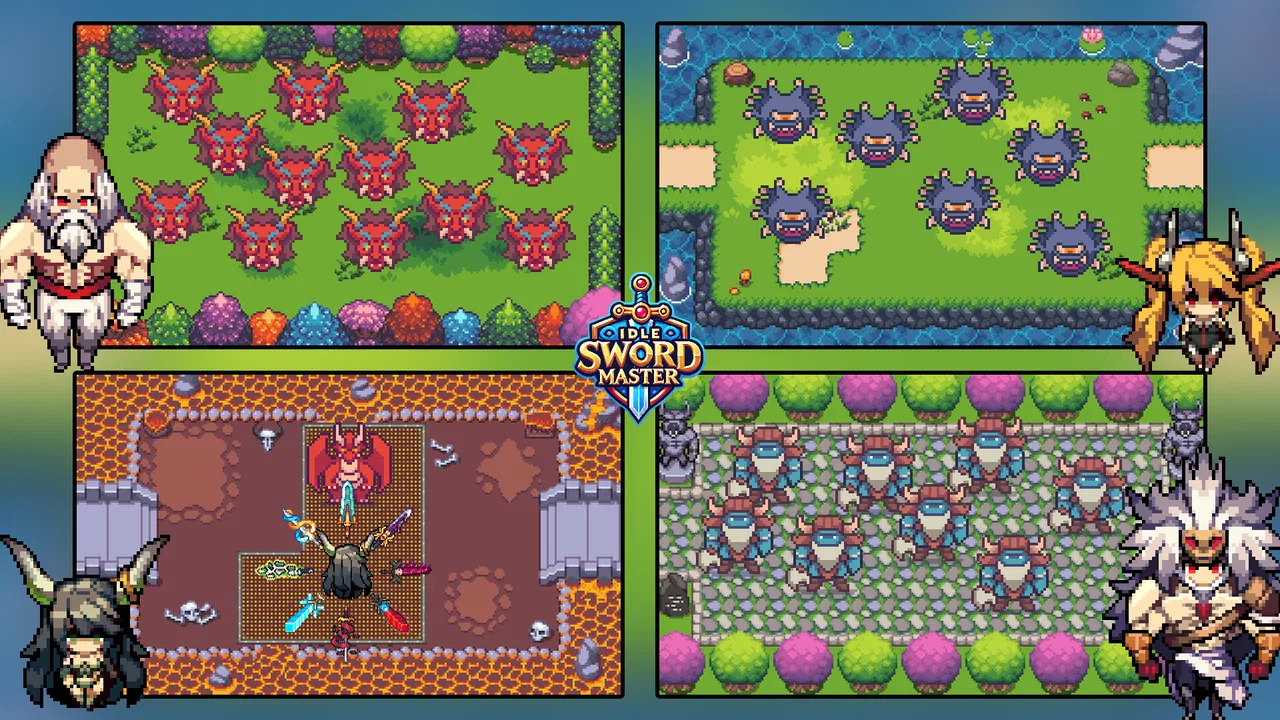
Idle Sword Master
- 4.4
- Rating
- 500.00K
- Installs
- Free
- Price

 Analysis by App-foxy
Idle Sword Master is the kind of simulation game I can leave running in the background and return to without feeling lost. Its central loop is easy to understand: combine swords, improve the avatar, and help a pet grow. That simplicity is both its biggest strength and its main limitation. I found it relaxing when I wanted short sessions with visible progress, but less satisfying when I was looking for deep strategy, a strong story, or demanding action.
Developed by MAD PIXEL, this free game sits in the casual simulation space rather than trying to compete with full-scale role-playing games. The presentation is built around gradual improvement, so the pleasure comes from making a small upgrade, checking the next reward, and deciding where to spend the resources available. It is a good fit for players who enjoy watching a character become stronger over time, especially when they do not want to devote a long uninterrupted session to a game.
My overall view is positive, with an important qualification: this is best treated as a compact progress game, not as a replacement for a more involved adventure or combat title. If you understand that before installing it, the design makes much more sense.
You May Also Like

 Blood Strike: 2.5 Anniversary
Blood Strike’s Loadouts Turn Every Drop Into a Tactical Gamble
A close look at Blood Strike’s custom loadouts: how fast access to signature weapons reshapes its battle royale rhythm, rewards preparation, and narrows the gap between fights.

 Pandora - Music & Podcasts
Pandora’s Music Is Easy to Start, but Harder to Recover
Pandora’s strength is its low-effort path from a seed to a station. Its weak spot is how much confidence it asks you to place in connection, setup, and quiet recovery.

 8 Ball Pool
 Is Built on Rivalries, Rematches, and Routine
A close look at the rivalries, rematches, shared routines, and unanswered safety questions that turn a quick pool match into a persistent mobile community.

 Samsung Music
’s Quiet Strength Is Playing What You Already Own
Its reach comes less from spectacle than from dependable access to a personal library. That simplicity is both the app’s strongest retention engine and its ceiling.

 AccuWeather: Weather Radar
AccuWeather Review: A Quick, Clear Forecast for Everyday Decisions
For everyday plans, the best forecast is the one you can understand quickly. AccuWeather makes rain timing, radar, and local conditions easy to act on, with a few trade-offs.

 Hill Climb Racing
Why Hill Climb Racing Still Turns Crashes Into One More Run
A tiny car, a bumpy hill and one more upgrade: Hill Climb Racing keeps resurfacing because its simple chaos makes every near-miss feel personal.
More From Our News Desk
View All News


How the sword-merging loop feels in everyday play
The most appealing part of the experience is the way sword merging turns equipment management into a simple decision-making routine. Instead of asking me to study a complicated build immediately, the game gives me a clear improvement path. Matching or combining weapons creates a sense of order, and the resulting upgrade makes the avatar’s progress easy to read.
I especially liked this structure during short breaks. In a realistic everyday scenario, I could open the game while waiting for a train, make a few equipment decisions, collect progress, and close it again without needing to remember a complicated sequence of controls. That makes it more convenient than action-heavy games, where leaving after a minute can feel pointless or where a missed input can ruin a run.
The sword system also gives the game a small but meaningful layer of planning. When several improvements are available, I do not want to merge everything automatically without thinking. It is more useful to pause and consider whether the next upgrade should support immediate strength, a smoother future progression path, or the development of another part of the account. Even within a straightforward idle format, that choice helps prevent the game from becoming a completely passive screen.
Still, players should keep their expectations realistic. Merging is satisfying because it is clear and repeatable, not because it offers the complexity of a traditional equipment-building role-playing game. Someone who enjoys comparing detailed statistics, testing unusual character builds, or controlling every attack may find the system too light. For me, it works best as a low-pressure routine rather than a deep theory-crafting challenge.
Avatar growth gives the routine a visible purpose
The avatar-leveling element is what stops the sword system from feeling like an isolated puzzle. Each improvement contributes to the sense that the character is moving forward, and that matters in an idle game where the player spends much of the time preparing the next step rather than actively fighting every moment.
I found it helpful to treat avatar growth as the main reason to keep the smaller upgrades organized. A pile of merged swords can feel rewarding on its own, but the loop becomes more coherent when I connect those upgrades to the character’s longer-term development. That mindset also makes it easier to decide when to stop spending resources on a minor improvement and wait for a more useful milestone.
The progression is approachable for newcomers because the goals are easy to understand. You do not need previous experience with idle games to recognize the basic rhythm: gather progress, improve the character, strengthen the equipment, and return later. The trade-off is that experienced idle players may recognize the pattern quickly and reach the point where the routine feels familiar rather than surprising.
One practical tip is to avoid opening the game only to tap through every available reward without checking the broader upgrade direction. The most enjoyable sessions came when I used a return visit to make one deliberate improvement rather than treating every notification as an instruction. That small habit makes the game feel more interactive and reduces the sense that I am merely clearing chores.
The pet adds warmth, but it also changes the priority list
The evolving pet is a useful addition because it gives progression a second emotional focus. The avatar represents power and advancement, while the pet makes the account feel a little more personal. I enjoyed having another reason to check back, especially when the main sword loop started to feel repetitive.
At the same time, the pet means that resources and attention can feel divided. Players who prefer a single, highly efficient upgrade route may find the extra development target distracting. I would not recommend treating every system as equally urgent. A better approach is to decide whether the current session is mainly about strengthening the avatar or moving the pet forward, then use the available rewards with that priority in mind.
This is one of the game’s more useful hidden lessons: idle progression is not only about collecting more, but also about avoiding scattered spending. Even without a complicated strategy guide, setting a short-term focus helps the game feel less random. It also makes returns more satisfying because I know what I was trying to accomplish before closing the app.
Where the game is strongest compared with similar choices
Compared with action-oriented fantasy games, this title is far easier to fit into a busy day. There is no need to reserve a long block of time for a mission, learn a demanding control scheme, or maintain constant attention. Compared with management simulations, it is more immediately visual and character-focused, since the reward is tied to a growing warrior and an evolving companion rather than to an abstract business or city.
That middle position is important. It offers enough fantasy progression to feel more personal than a basic number-goes-up idle app, while remaining much less demanding than a conventional role-playing game. I would choose it over a more active alternative when I want a calm progression loop. I would choose the alternative instead when I want exploration, direct combat, narrative decisions, or a strong sense of discovery.
The game’s audience response supports the idea that it is accessible: it holds a 4.4 average from around 14 thousand ratings and has passed 500 thousand installs. Those figures do not guarantee that every player will enjoy the loop, but they do place it among the more approachable options for someone curious about this style of mobile game.
Limitations, spending pressure, and who should skip it
The clearest weakness is repetition. Merging swords, leveling the avatar, and evolving the pet form a pleasant cycle, but the same cycle can lose its freshness if I play for long stretches. This is not a game I would recommend for an evening when I want constant surprises. It works better when opened in small visits, with enough time between sessions for the next improvement to feel meaningful.
The free entry point is welcome, but optional purchases ranging from $1.99 to $99.99 per item mean that spending can become part of the progression conversation. I would advise setting a personal limit before getting invested. The game is easier to enjoy when purchases are treated as optional convenience rather than as the expected solution to every slow moment. Players who dislike any form of monetized acceleration should think carefully before committing time to an idle title.
Another point worth considering is the age guidance. The game is rated Everyone 10+, which makes it broadly approachable, but parents should still remember that a free mobile game with in-app purchases deserves the same spending boundaries as any other game. A simple device-level purchase restriction can prevent an accidental expense and let younger players enjoy the progression without turning every reward into a buying decision.
The current version is 1.0.5.8, and the game requires Android 7.0 or later. That makes it suitable for many older Android devices, although actual comfort will naturally depend on the phone and how much background activity the player allows. I would check compatibility before planning to use it on an especially old handset, particularly if smooth menus and quick loading matter to you.
There is also a psychological limitation to idle design: the game can encourage frequent checking. For some players, that is the appeal. For others, repeated returns can make the experience feel like a list of small obligations. I found the healthiest approach was to open it on my own schedule instead of responding to every possible prompt. If you prefer games that end cleanly after a match or level, this ongoing progression model may feel less satisfying.
Who will get the most from it
I would recommend this game to someone who likes fantasy-themed progression but does not want to control every battle. It is particularly suitable for players who enjoy organizing upgrades, seeing equipment improve, and making occasional decisions during short sessions. It can also work well as a secondary game beside a more demanding title, because it asks for less concentration and provides a different rhythm.
It is a reasonable starting point for someone new to idle games. The sword-merging idea is easier to grasp than a large collection of interconnected systems, while the avatar and pet give the progress a clear identity. New players should focus on learning which improvements feel most useful rather than trying to optimize everything immediately. The game is more enjoyable when early sessions are used to understand the rhythm instead of chasing perfect efficiency.
I would not make it my first recommendation for competitive players, fans of story-driven adventures, or anyone who wants precise control over combat. It is also a poor fit for people who become frustrated by repeated upgrade cycles or who want every session to offer a new environment and objective. Those players would be better served by a conventional role-playing game, an action title, or a richer management simulation.
For families, the Everyone 10+ rating is a helpful indication of the intended audience, but the purchase system still deserves attention. For adults, the more important question is whether the relaxing routine feels rewarding or merely slow. If you enjoy incremental improvement, the pacing can be comfortable. If you need dramatic changes from one session to the next, it may feel underpowered.
Small habits that make the experience better
My first practical recommendation is to use each return visit with a purpose. Before closing the game, decide whether the next session is about merging equipment, improving the avatar, or advancing the pet. This prevents resources from being spread too thin and gives the otherwise simple loop a clearer sense of direction.
Second, do not judge the game by a single long session. Idle systems reveal their value over repeated short visits, while extended tapping can expose the repetition too quickly. I had a better impression when I treated it as a five-minute check-in rather than a game demanding continuous attention.
Third, keep purchase decisions separate from frustration. If progress feels slow, closing the game and returning later is often a better test of whether I genuinely enjoy the design than buying an immediate shortcut. This is especially important because the available item range reaches from small purchases to much larger ones. A player who sets boundaries early is more likely to experience the free progression on its own terms.
Finally, compare it honestly with what you already play. If your current game gives you direct combat and exploration, this one can serve as a calmer companion. If you already have several idle progression games, the sword-and-pet theme may not be enough to overcome the familiar structure. The right choice depends less on the fantasy setting than on how much repetition you personally find relaxing.
My verdict after spending time with the progression loop
Idle Sword Master succeeds because it understands the appeal of uncomplicated improvement. The merged swords are easy to follow, avatar development gives the routine direction, and the evolving pet adds personality to an otherwise numbers-focused format. I can see why it has attracted a broad audience, and I think its free starting point makes it easy to try without a major commitment.
Its weaknesses are just as clear. The loop can become repetitive, the strategic depth is limited compared with more substantial role-playing games, and in-app purchases require sensible boundaries. The game is not trying to be a dramatic adventure, and judging it by that standard would be unfair. Its real question is whether small, regular upgrades are enough to keep you interested.
For me, the answer is yes when I want a quiet mobile game for spare moments. I would recommend it to casual players who enjoy merging equipment and watching a character and companion grow, especially those who prefer low-pressure sessions. I would skip it if I wanted a story, demanding combat, or a progression system that constantly introduces new ideas.
As a free simulation game from MAD PIXEL, it offers a clear and accessible routine rather than a large, complicated world. That is a modest ambition, but it is handled well enough to be worthwhile. The best way to enjoy it is to treat it as a relaxed progress companion, not as a full replacement for a deeper adventure game.
FAQs for Idle Sword Master
01What is Idle Sword Master?
Idle Sword Master is an incremental role-playing game in which you develop a powerful sword-wielding hero and fight enemies automatically. Battles continue with minimal input, allowing you to earn rewards, upgrade equipment, unlock abilities, and improve your character even when you are not actively playing. It is designed for players who enjoy gradual progression rather than complex real-time controls.
02How does progression work in Idle Sword Master?
Progression is based on upgrading your hero, weapons, armor, skills, and other supporting features as you advance through increasingly difficult stages. You generally collect coins, materials, and other rewards from battles, quests, events, and idle earnings. When progress slows, improving equipment and abilities or revisiting earlier content can help you build enough strength to continue.
03Can Idle Sword Master be played offline?
The game may allow certain parts of its idle progression or previously available content to continue without a constant internet connection, but online access is commonly required for features such as cloud synchronization, advertisements, events, purchases, rankings, and reward collection. Offline behavior can vary by device and version, so players should not assume that every feature works without an internet connection.
04Is Idle Sword Master free to download and play?
Idle Sword Master is generally available as a free download, but it may include optional in-app purchases and rewarded advertisements. Purchases can provide premium currency, bundles, faster progression, or convenience items, while ads may offer extra rewards or bonuses. You can usually play without spending money, although progress may feel slower and some upgrades may require more time.
05Is Idle Sword Master suitable for casual players?
Idle Sword Master is particularly suitable for casual players who prefer short sessions and automatic combat. You can check progress, collect accumulated rewards, upgrade your character, and return later without needing to control every battle manually. However, players who dislike repetitive progression, frequent upgrade screens, advertisements, or monetization systems may find the experience less appealing over time.
Pros
- Simple idle combat makes progress easy with little active input.
- Hero upgrades and equipment provide a satisfying sense of progression.
- Short play sessions suit users who only check in occasionally.
- Fantasy visuals and sword-focused gameplay are easy to understand.
- Offline-style rewards help maintain progress between active sessions.
Cons
- Progress can slow noticeably when upgrade costs begin to rise.
- Repeated battles may feel monotonous after extended play.
- Some rewards and upgrades may encourage frequent ad viewing.
- Limited strategic depth may disappoint players seeking complex combat.
- Device notifications can become distracting if enabled for rewards.

Idle Sword Master
Gallery